





Statement issued by the Southern Transitional Council
The Southern Transitional Council (STC) has welcomed the Kingdom of Saudi Arabia’s invitation to spo...
In the name of Allah, the Most Gracious, the Most Merciful
The Constitutional Declaration of the State of South Arabia
· Based on the Historic Aden Declaration issued on 4 May 2017.
· And the decree to form the Southern Transitional Council (STC) and its documents on 11 May 2017.
· And the relevant regional and international resolutions, agreements, and statements concerning the South as a state and the cause of the people of the South: UN General Assembly Resolution 1514 of 1960, UN General Assembly Resolution 2310 of 1967, UN General Assembly Resolution 2625 of 1970, UN Security Council Resolution 924 of 1994, UN Security Council Resolution 931 of 1994, the 1994 statement of the Gulf Cooperation Council, the 2019 Riyadh Agreement, and the 2022 GCC Consultations.
· And the Southern National Charter was signed on 8 May 2023 by representatives of Southern political components and forces.
· And in response to the continuous demands of our people of the South, the latest of which were the statements issued from various governorates of the South in December 2025 by the sit-ins and massive mass gatherings demanding the declaration of the State of South Arabia.
· And the Political Declaration Statement.
· And as required by the public interest of the people of South Arabia.
We issue the following Constitutional Declaration.
Chapter One
The General Foundations of the State
Article (1):
The State of South Arabia is an independent sovereign state within the internationally recognised borders of the former "People's Democratic Republic of Yemen". Its capital is Aden. It is part of the Arab and Islamic nation. Its language is Arabic, its religion is Islam, and Islamic Sharia is a main source of legislation.
Article (2):
The political system in the State of South Arabia is based on the principle of separation of powers. It is a civil, democratic system established and based on popular will, the rule of law, justice, pluralism, and good governance. The people shall determine the nature of the political system through a public referendum after the transitional phase.
Article (3):
A transitional phase of two years is set, which may be extended for a period not exceeding the original duration, to accomplish the tasks stipulated in this Declaration and other laws, by a decree of the transitional legislative body. It aims to prepare the necessary conditions and circumstances for building a civil, democratic state established and based on popular will, the rule of law, and good governance.
Article (4):
The State of South Arabia is committed to working by the Charter of the Arab League, the Charter of the United Nations, the Universal Declaration of Human Rights, and the generally recognised principles of international law, and is committed to all ratified treaties and agreements.
Article (5):
The state adopts during the transitional phase an economic policy based on:
1. Freedom of economic activity ("free economy") without compromising the rules of social economy, ensuring the exploitation of all resources to raise the living standard of the citizen and increase job opportunities.
2. Public ownership belongs to the people and contributes to economic activity. It may not be exploited for purposes other than those for which it is designated.
3. Private property is an effective element in serving the national economy. It is protected and may not be infringed upon except in the cases specified by law.
Article (6):
The state is committed to:
4. The existing and ongoing legal investment and partnership contracts in the territory of the State of South Arabia between foreign public or private companies and the previous authorities, after reviewing, auditing, and verifying their legality, legitimacy, and conformity with the supreme interest of the people of South Arabia.
5. The state guarantees and protects all legitimately and legally acquired rights under the previous authority for natural or legal persons, regardless of their nationality.
6. The enforcement of this Constitutional Declaration does not entail any automatic obligation regarding debts, undertakings, or contracts concluded under previous systems, except within the limits approved by the state according to an independent legal review.
7. Subsequent laws shall regulate the mechanisms for review, settlement, renegotiation, or cancellation in a manner that achieves justice, preserves economic stability, and safeguards the rights of the state and investors alike.
Article (7):
8. The Armed Forces and security services have the task of protecting the state, the integrity of its territory, its security, and safeguarding the Constitution and laws. The state is the one that establishes them. No individual, group, or political organisation may create forces or military or paramilitary formations for any purpose and under any name.
9. The state is committed to working according to a strategic vision to combat terrorism and extremism in all its forms, images, and sources, in partnership with the regional and international communities.
Article (8):
The state sponsors the family as the fundamental pillar of society and sponsors motherhood, childhood, adolescence, and youth. It guarantees the real participation of women alongside men in all fields.
Article (9):
Citizens are equal before the law in rights and duties without discrimination among them for any reason. The state guarantees to every citizen all political, economic, cultural, and social rights stipulated in the Universal Declaration of Human Rights (UDHR), the International Covenants on Civil and Political Rights and on Economic, Social and Cultural Rights, and other relevant international covenants.
Chapter Two
Authorities of Governance During the Transitional Phase
Article (10):
1. The Head of State is the President mandated with restoring the state. He is the Supreme Commander of the Armed Forces, the head of the transitional government, and the one who manages state affairs during the transitional phase.
2. The President assumes the following tasks and competencies:
a. Representing the state both at home and abroad.
b. Appointing senior state officials, civilians and military, and its diplomatic representatives abroad, and relieving and dismissing them from their positions.
c. Leading the Armed Forces and Security and appointing their commanders.
d. Establishing diplomatic missions.
e. Accrediting heads of foreign diplomatic missions.
f. Declaring a state of emergency and general mobilisation.
g. Issuing laws after their ratification by the legislative authority and law decisions in case of necessity during the period when the legislative authority is not in session.
h. Issuing decrees to ratify agreements and treaties and the necessary decisions to establish public utilities, interests, and temporary committees concerned with implementing the tasks of the transitional phase.
i. Any other tasks and competencies stipulated in this Declaration and the effective laws.
3. The President of the State appoints one or more deputies, who act on his behalf in his absence and assist him in his work and in carrying out what he assigns.
4. The President of the State issues a decree to form the transitional government under his chairmanship, composed of competent, experienced, and honest persons, to manage everything the state must do in the transitional phase, including:
a. Directing, coordinating, and following up on the work of ministries, their affiliated bodies, public authorities, and institutions, ensuring the preservation of state interests, the protection of citizens' rights, and the provision of services.
b. Issuing executive regulations for laws and the administrative decisions implementing them, and monitoring their implementation according to the law.
c. Any competencies related to implementing the tasks of the transitional phase and stipulated in this Declaration and the effective laws.
Article (11):
The following bodies report to the President of the State:
5. The General Intelligence Service.
6. The National Planning and Policy-Making Body, which includes:
· The National Centre for Planning and Decision Support.
· The National Centre for Information and Documentation.
· The National Centre for Crisis Monitoring and Forecasting.
· The Central Statistical Organisation.
7. The National Defence Council.
8. The Counter-Terrorism Apparatus.
9. Other specialised bodies or committees required to achieve the goals and entitlements of the transitional phase, whose formation and organisation are issued by presidential decisions and decrees.
Article (12):
10. Members of the government shall take the constitutional oath before the President of the State before assuming their work.
Article (13):
11. The tasks and powers of the legislative authority during the transitional phase are assumed by the Legislative Body with its two chambers: the Transitional Legislative Council and the Senate.
12. The Transitional Legislative Council consists of (171) members representing all Southern governorates. Its formation and the selection of its members are issued by a decree of the President of the State after presentation and ratification by the General Assembly of the STC.
13. The Senate consists of one hundred and one (101) members representing tribal, social, economic, scientific, professional, and religious elites. Its formation and the selection of its members are issued by a decree of the President of the State after presentation and ratification by the General Assembly of the STC.
14. Women and youth representation shall be guaranteed in the two chambers of the Legislative Body stipulated in paragraphs (2 and 3) of this article.
15. Following the issuance of this Declaration, the President of the State issues a presidential decree regulating the representation criteria in the two chambers of the Legislative Body and the selection of their members.
16. The sessions of the Legislative Body are chaired by the Chairman of the State.
17. The President of the State appoints one of his deputies or whomever he deems appropriate as Speaker of the Transitional Legislative Council and also appoints a deputy speaker and a rapporteur for the Council.
18. The President of the State appoints one of his deputies or whom he deems appropriate as Chairman of the Senate and also appoints a deputy speaker and a rapporteur for the Council.
Article (14):
19. The judiciary is an independent authority financially and administratively. It assumes the administration of justice, ensuring the sovereignty of the Constitution and the law, and protecting rights and freedoms. Judges are independent and are subject only to the law.
20. The bodies of the judicial authority continue to perform their tasks until the issuance of the law regulating them.
Chapter Three
Tasks of the Transitional Phase
Article (15):
In addition to the tasks stipulated in Article (10) of this Declaration, the President of the State shall, during the first sixty days from the date of the commencement of the implementation of this Declaration, take the following measures:
1. Form the transitional government and appoint governors of governorates, security directors, senior state officials, diplomatic representatives to foreign states, and the head of the Central Auditing and Accounting Organisation.
2. Issue a presidential decree on representation and selection criteria for members of the two chambers of the Legislative Body.
3. Form the Supreme Judicial Council and appoint members of the Supreme Court, the Anti-Corruption Commission, the Governor of the Central Bank, and the Central Auditing and Accounting Organisation according to the law.
4. Issue the regulations organising the auxiliary apparatuses of the Presidency of the State and its affiliated bodies and issue the decisions for their formation.
5. Any other tasks stipulated in this Declaration and the effective laws.
Article (16):
The transitional government, immediately after taking the oath, shall undertake the following tasks of the transitional phase:
6. Setting the state's general policy, preparing its general plan, its government programme, and the general budget for the first year, and presenting them to the Transitional Legislative Council within a maximum period of thirty days.
7. Preparing a matrix for administrative and financial reforms, proposing the necessary legislation for it, and submitting it to the Senate within a period not exceeding sixty days.
8. Seeking financial resources to finance the expenditures required to implement the government's plan and programme, preserve citizens' rights, and implement the tasks of the transitional phase.
9. Inventorying all state assets and resources, its rights with others, and its obligations towards others under previous international, regional, and bilateral agreements in accordance with the rules of international law.
10. Proposing the state's fiscal, monetary, and banking system and the regulating legislation and submitting it to the President of the State within a maximum period of ninety days, to take the necessary action regarding them within his powers.
11. Doing everything possible to restore international recognition of the state in accordance with the UN Charter and the principles of international law and to restore its membership in the United Nations, the Arab League, and international and regional organisations.
12. Any other tasks stipulated in this Declaration and the effective laws, provided they do not conflict with the provisions of this Declaration.
Article (17):
The Transitional Legislative Council undertakes the following tasks and powers:
13. Approving the laws required for the President of the State to take the measures stipulated in Article (15) of this Declaration, including the Judicial Authority Law, the Law on High Positions, the Diplomatic and Consular Corps Law, the Central Auditing and Accounting Organisation Law, the Anti-Corruption Law, and other related laws, within a maximum period of forty-five days from the enforcement of this Declaration.
14. Approving the laws required to accomplish the tasks of the transitional phase, including the Elections Law, Transitional Justice Law, and the Administrative Division of the State Law.
15. Discussing and approving the state's general budget submitted by the government and its final account, and issuing them as law within the period specified by law.
16. Ratifying the programme of the transitional government and directing recommendations to it on general matters and matters related to its performance of its tasks or the performance of any of its members. It may form a special committee or assign one of its committees to investigate a matter that conflicts with the public interest or examine the performance of one of the ministries or public institutions and authorities and submit a report thereon to the Council.
17. The Council may direct questions to its members or their deputies on any subject within their competence, and the addressee must answer. Based on the foregoing, the Council may request the President of the State to conduct an investigation regarding any violation proven to it or recommend changing any member of the government or one of the officials of its apparatuses by a reasoned decision issued by a majority of its members.
18. Ratifying international treaties that entail financial obligations on the state or whose implementation requires their issuance as law.
19. Approving its internal bylaws in its first session, provided they do not contradict this Declaration.
20. The Council forms its specialised committees according to the internal bylaws.
21. Any other tasks or competencies stipulated in this Declaration.
Article (18):
The Senate undertakes the following tasks during the transitional phase:
22. Proposing legislation required to accomplish the tasks of the transitional phase and presenting it to the Transitional Legislative Council.
23. Discussing, giving opinions, and ratifying legislative proposals submitted by the President, the government, or other competent authorities, as well as those approved by the Transitional Legislative Council and referred by the President for reconsideration. In case of non-ratification, the proposal may not be resubmitted until after forty days.
24. Organising national and community dialogues with all components, political and social elites, civil society organisations, Southern professional unions, and specialised scientific events, aiming to reach an agreement on solidifying the name of the Southern state, its flag, national anthem, political system, administrative division, basic components, electoral system, and what is stated in the Southern National Charter.
25. Preparing a national consensus document containing the results produced by the national and community dialogues and various scientific events to be an objective source for drafting the state's permanent constitution and its legislation.
26. Ratifying projects, plans, and general programmes for accomplishing the tasks and entitlements of the transitional phase prepared by the President of the State or the government, and giving opinions on other topics referred to it by the President.
27. Ratifying the matrix of reforms proposed by the transitional government within a maximum period of thirty days from the date of receipt.
Article (19):
The Transitional Legislative Body undertakes the following tasks:
28. Approving the general directions plan of the state during the transitional phase.
29. Ratifying political agreements and treaties related to defence, alliance, peace, and truce.
30. Approving the national consensus document prepared by the Senate.
31. Approving the law forming the Higher Elections Commission, regulating the rules of its formation to ensure representation of all governorates, national forces and elites, women, and youth, taking into account what is contained in the national consensus document regarding that.
32. Forming the National Committee for preparing the draft constitution according to the law regulating it.
Article (20):
33. The President of the State shall issue a law forming the Committee and defining its tasks and powers.
34. The Committee commences its work immediately after the issuance of its formation decree, provided it completes submitting the draft constitution to the Legislative Body within a period not exceeding six months from the date of its formation.
35. The Legislative Body discusses the draft constitution and takes a decision to approve or not approve the project within a maximum period of sixty days from receiving it from the Committee.
36. The validity of the Council's decision requires the attendance of no less than three-quarters of the Council's members.
37. If the draft constitution is approved by a two-thirds majority of those present, it is submitted to a popular referendum. If it is not approved, the National Committee for Drafting the Constitution is tasked with redrafting it and presenting it again to the Council within a period not exceeding sixty days.
38. If the draft constitution is approved, it is presented for a public referendum and is considered the general constitution of the state if approved by the percentage specified in the General Elections and Referendum Law.
Article (21):
After the referendum on the constitution, the following procedures shall be taken:
39. The Transitional Legislative Council discusses and approves the General Elections and Referendum Law.
40. The President of the State shall issue the General Elections and Referendum Law and a decree forming the Higher Elections Commission to organise the electoral process.
41. General elections for parliament are held within a period not exceeding six months from the date of issuance of the decision forming the Higher Elections Commission. The period may be extended if necessary by a decree of the President of the State.
42. The Legislative Body ratifies the election results and calls the elected parliament to convene within a period not exceeding thirty days. With the convening of the first session of parliament, the legislative powers of the transitional legislative authority shall end.
Article (22):
43. The President of the State shall be elected according to the provisions of the Constitution and the General Elections and Referendum Law within a period not exceeding ninety days from the date of the convening of the first session of the elected parliament.
44. The transitional phase shall end after the elected president takes the constitutional oath before the parliament and commences his duties.
Chapter Four
Final Provisions
Article (23):
The effective laws, decrees, and regulations shall remain in force, insofar as they do not conflict with the provisions of this Declaration and the governing references of the transitional phase, until they are repealed, with the exception of legal documents of a constitutional nature, which shall be considered annulled.
Article (24):
The central and local executive and judicial state authorities shall continue to exercise their tasks according to previous legislation and Southern national administration until decrees are issued by the state to regulate them according to this Declaration and in a manner that does not conflict with it.
Article (25):
Dealing with the monetary currency (the new issue Yemeni riyal) shall remain in use until the restructuring of the financial, monetary, and banking system is completed by the competent state apparatuses under this Declaration and the legislation issued pursuant to it. The transitional government shall take the necessary measures to ensure economic stability.
Article (26):
The state's emblem, flag, and national anthem in the transitional phase are determined by a law issued by the President of the State.
Article (27):
Amendment of this Declaration is permitted with the approval of no less than two-thirds of the members of the Transitional Legislative Body.
Article (28):
a. In case the position of President of the State becomes vacant, one of his deputies assumes his duties until the end of the transitional phase.
b. In case the position of vice president becomes vacant, the president appoints a deputy instead.
C. In case both the positions of President and Vice President become vacant, the President of the Legislative Council assumes the duties of the President of the State for a period of sixty days, during which he calls the Legislative Body to elect a President for the state.
Article (29):
The text of the constitutional oath:
"I swear by Allah Almighty to work sincerely for the State of South Arabia and its president, to preserve its independence, unity, and the integrity of its territory, to fully safeguard the interests of its people, to respect the Constitution and the law, and to perform my duty with all honesty and devotion."
Article (30):
This Declaration shall come into force from the date of its issuance and shall be published in the Official Gazette.
The Southern Transitional Council (STC) has welcomed the Kingdom of Saudi Arabia’s invitation to spo...

The Southern Transitional Council (STC) expresses its strongest condemnation of the Saudi aggression...

The Southern Transitional Council (STC) has followed the statement issued by the brotherly Kingdom o...
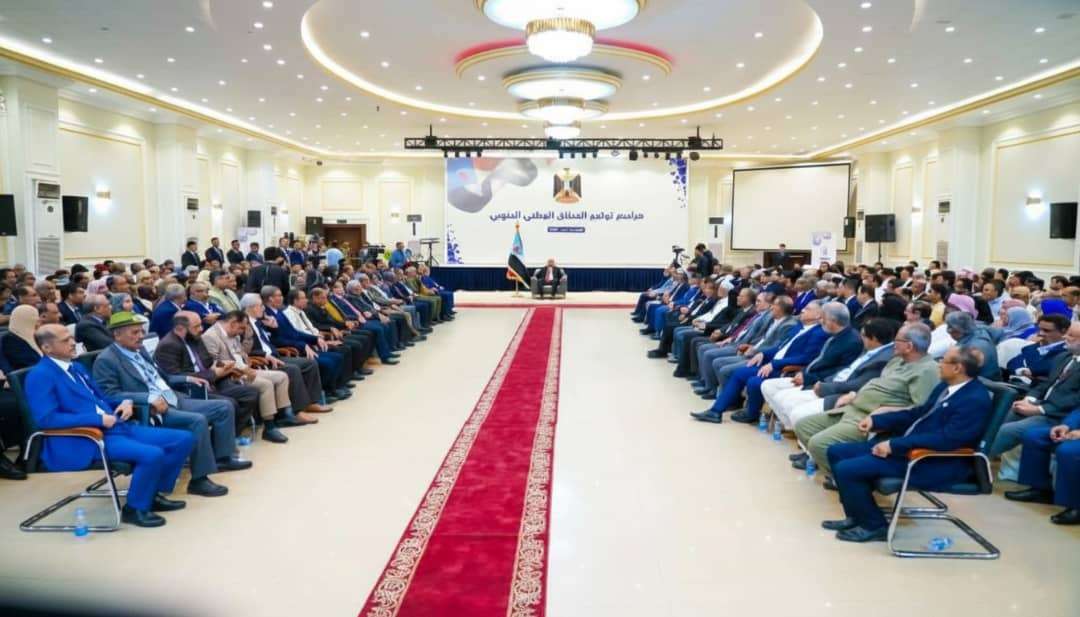
In the name of Allah, the Most Gracious, the Most MercifulThe political parties, components, and for...